


In the context of the rapidly unfolding Fourth Industrial Revolution, speed, efficiency, and cost optimization have become vital factors for businesses. Manual warehousing and logistics models, heavily reliant on human labor, are gradually revealing significant limitations: high costs, errors, unstable productivity, and difficulty in scaling up.
Therefore, robotic logistics are no longer a futuristic concept, but have become a practical automation solution, widely applied in warehouses, factories, logistics centers, and modern e-commerce.
What are delivery robots?
Warehouse robots are automated devices programmed to move, lift, and transport goods within warehouse or factory spaces with little to no human intervention. These robots operate based on a combination of:
– Digital mapping (SLAM)
– Safety sensors
– Artificial intelligence (AI)
– Intelligent navigation system
Key capabilities of the material handling robot:
– Self-orientation and movement in complex spaces
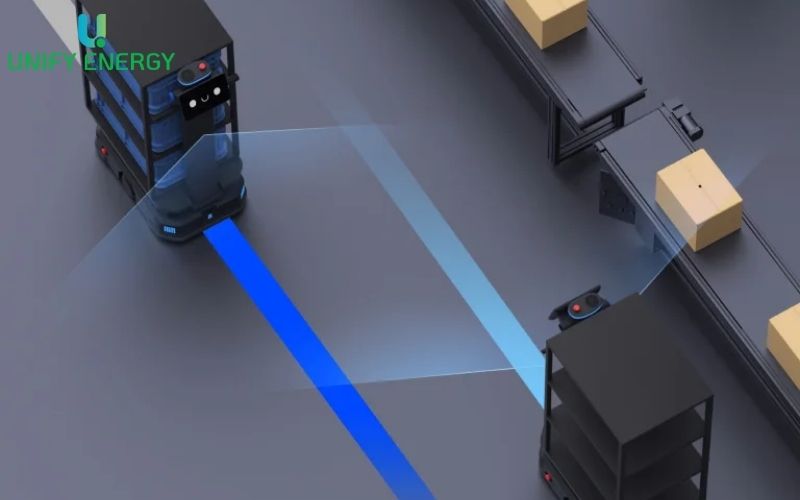
– Real-time obstacle detection and avoidance
– Optimized travel routes to save time
– Continuous material handling between areas in the warehouse
Unlike fixed conveyor belts or traditional forklifts, material handling robots are highly flexible, easily scalable, safer, and suitable for modern warehouse models where layouts frequently change.
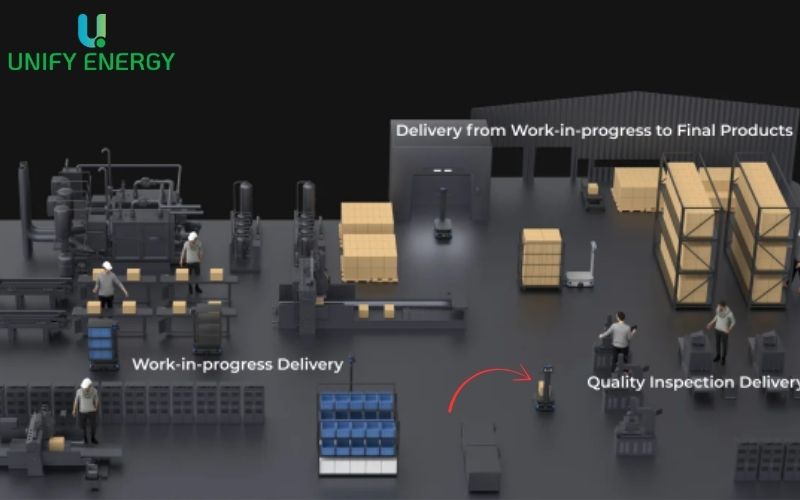
Key advantages of cargo transport robots
Reduced labor costs: Robots replace humans in repetitive, strenuous, and time-consuming transportation tasks. Thanks to their ability to operate continuously 24/7, businesses can significantly reduce personnel costs and the risk of labor shortages.
Increased productivity and accuracy: Robots transport goods reliably and accurately according to system commands, minimizing errors during the movement and delivery of goods. This significantly improves warehouse productivity.
Optimize warehouse space: With flexible and precise movement capabilities, robots help organize goods flow more efficiently, maximizing storage space, especially suitable for warehouses with high goods density.
Ensure workplace safety: Thanks to a 360° sensor system and intelligent collision avoidance mechanism, robots help minimize workplace accidents, especially when transporting heavy or bulky goods.
Easy system integration: Goods transport robots can connect to WMS, ERP, and MES systems, allowing for real-time monitoring of goods status and optimizing the entire operational chain.
>>See more: SEER SPT-1000 Intelligent Automatic Pallet Lifting Robot
Applications of robotic goods transport in warehouses.
Robotic cargo handling devices are widely used in modern warehousing to automate the movement of goods, reduce reliance on human labor, and improve operational efficiency.
E-commerce warehouse
In modern e-commerce warehouses, robotic delivery systems play a central role in automating the order processing workflow. These robots retrieve items from shelves, move products to the packaging area, and transfer orders between different processing zones. Thanks to their continuous and precise operation, robots help warehouses handle large order volumes in a short time, particularly effectively during peak seasons, while ensuring fast and consistent delivery schedules.
Industrial production
In electronics, mechanical, and automotive manufacturing plants, robotic transport is used to move raw materials and components from warehouses to production lines, move semi-finished products between stages, and transport finished products to storage areas. The application of robots helps maintain a continuous flow of materials, minimizes production disruptions, and improves the overall operational efficiency of the factory.
Logistics center
In large-scale logistics centers and distribution warehouses, robots assist in gathering goods, moving pallets and containers from storage areas to receiving and dispatch areas. Robots significantly shorten order preparation time, reduce the workload for human workers, and increase the capacity to handle large volumes of goods daily, especially in continuously operating logistics models.
Hospital
In hospital settings, delivery robots are used to deliver medications, medical supplies, equipment, and meals to wards and departments. The use of robots reduces the workload for medical staff, minimizes direct contact, and ensures accurate, safe, and timely delivery.
Supermarkets and retail
In supermarkets and retail systems, robots assist in moving goods from back-office warehouses to display areas. This allows for quick and continuous restocking, reducing shelf shortages and enhancing the customer shopping experience.
Food processing plant
In food processing plants, robotic conveyors are responsible for moving raw materials, semi-finished products, and finished products to the packaging area. Robots help reduce direct contact between humans and products, ensuring food safety and hygiene, while maintaining a closed and stable production process.
>>Watch Video: Application of ABM-300JZ cargo handling robot for transporting trolleys in warehouses
Common types of cargo handling robots
Depending on the size of the warehouse, operational specifics, and level of automation, businesses can choose from a variety of different types of material handling robots. Each type of robot is designed to meet a specific set of needs in warehousing and manufacturing.
AGV (Automated Guided Vehicle)
AGVs are a type of robotic system used for transporting goods, moving along a fixed route guided by magnetic lines, rails, or sensors. These robots have a simple structure, reasonable investment costs, and are easy to deploy. AGVs are suitable for warehouses with stable routes, infrequent changes, and repetitive transport needs.
AMR (Autonomous Mobile Robot)
AMRs are a smarter generation of material handling robots capable of building maps and optimizing routes using artificial intelligence and navigation systems. AMRs can flexibly avoid obstacles and adapt quickly to the constantly changing warehouse environment. They are a popular choice in modern warehouses and logistics centers.
Tugger Robot
Towing robots are specifically designed to tow heavy loads of goods or clusters of goods from one area to another. This type of material handling robot is commonly used in large-scale manufacturing plants or warehouses where the safe and stable movement of heavy loads is required.
Forklift AGV/AMR Robot
Pallet handling robots are an alternative to traditional forklifts, capable of lifting, lowering, and placing pallets onto shelves or storage areas. These internal delivery robots help reduce the risk of workplace accidents, increase accuracy, and ensure continuous operation within warehouses and factories.
Multifunctional integrated transport robot
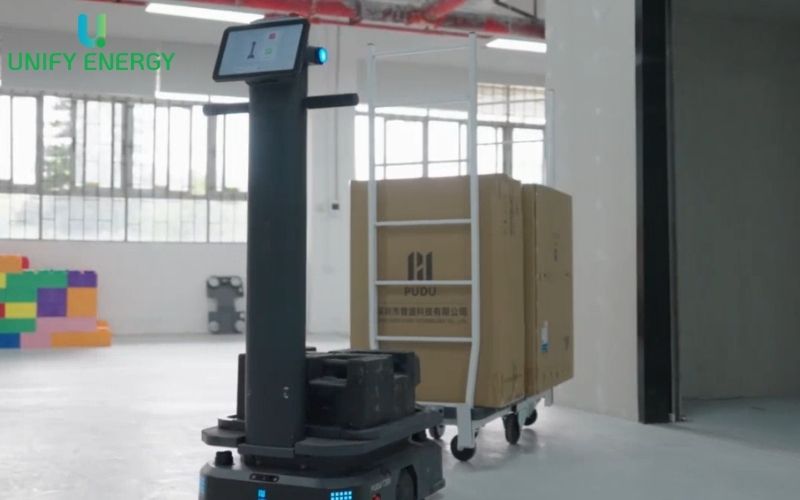
Multifunctional integrated robots are advanced material handling robots that combine multiple functions in one device, such as transporting, pulling, lifting, 360° obstacle avoidance, IoT connectivity, and real-time data management. Thanks to AI-powered navigation and integrated warehouse management systems, these robots optimize the entire automation process.
For example, the PUDU T300 or ABM 300JZ robots can handle various tasks such as transporting goods, internal delivery, maneuvering flexibly in complex spaces, and connecting with WMS systems to improve operational efficiency.
>>See more: Intelligent autonomous patrol robots
Why should businesses invest in delivery robots?
In the context of rapid digital transformation, robotic delivery is becoming a strategic solution to help businesses optimize warehousing operations and enhance competitiveness. In Vietnam, the boom in e-commerce, the demand for fast delivery, and the continuous development of industrial zones are driving businesses to seek more effective automation solutions.
Optimize processing speed and operational performance
Warehouse robots significantly reduce the time it takes to move goods within a warehouse, thereby increasing order processing speed and material flow. These robots can operate continuously and precisely along optimized routes, helping businesses maintain stable performance even during peak periods.
Reduce operating costs in the long term
Although the initial investment cost for robotic air cargo handling is small, in the long term, robots significantly reduce labor costs, costs arising from errors, and workplace accident risks. Automating the handling process helps businesses better control costs and optimize operating budgets.
Flexible to scale up as development develops
One of the major advantages of robotic warehouse management is its flexible scalability. Businesses can deploy a few robots in a small warehouse and then easily upgrade to a large-scale automation system as needs grow without having to change the entire infrastructure.
Stabilize resources and reduce reliance on labor
Robots help businesses reduce their reliance on manual labor, especially in the context of labor shortages or rising labor costs. Robotic delivery maintains consistent productivity 24/7, unaffected by shifts, weather, or human factors.
Enhance safety and accuracy
With intelligent sensor systems and collision avoidance mechanisms, goods transport robots help minimize workplace accidents in warehouses and factories. At the same time, precise delivery according to system commands helps reduce loss, errors, and damage to goods.
Creating a sustainable competitive advantage
Businesses that invest early in robotic logistics will have a clear advantage in terms of speed, cost, and scalability. This is a crucial foundation for building a modern warehousing model, ready to adapt to changing market conditions and future customer needs.
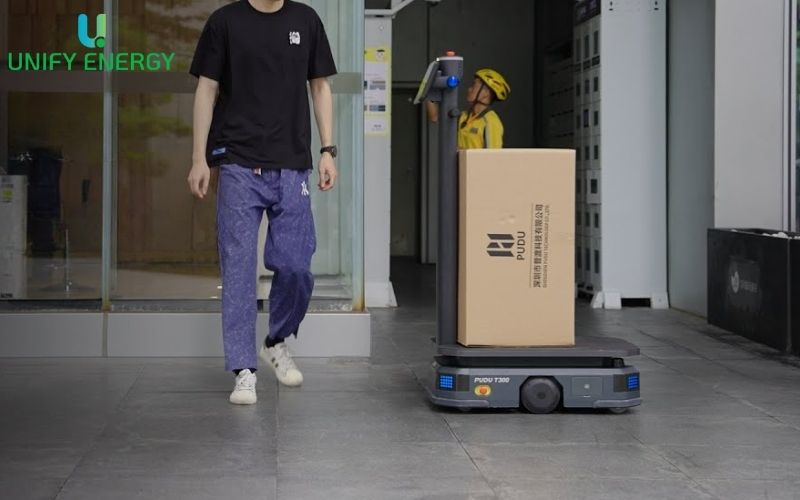
Key factors to consider when choosing the right cargo handling robot.
Choosing the right material handling robot is crucial to warehouse operational efficiency and return on investment. Businesses need to comprehensively evaluate various technical, operational, and future expansion factors to ensure the robot meets their actual needs.
Scale and specific characteristics of warehousing
Each warehouse has different dimensions, layouts, and movement flows. Businesses need to clearly identify whether the warehouse has fixed routes or frequently changing routes to choose the appropriate type of robot. For stable warehouses, AGVs are a reasonable choice; while for flexible warehouses, AMRs with self-navigation capabilities should be prioritized.
Type of goods and transport load
Robots used for transporting goods need to be able to handle the correct load capacity and type of goods, such as cartons, pallets, components, or bulky items. The choice of lifting robot, towing robot, or floor-moving robot depends directly on the actual transport needs.
Frequency and intensity of activity
Businesses need to assess how many hours a day the robots will operate and the level of continuity of the transportation process. Warehouses operating 24/7 require robots with high durability, large-capacity batteries, and automatic charging capabilities to maintain consistent performance.
Level of automation and system integration
Warehouse robots need to be able to integrate with warehouse management systems (WMS), ERP, or MES. Intelligent connectivity and coordination capabilities allow the robots to operate synchronously with the entire warehouse process and reduce manual intervention.
Safety and technical standards
Safety is a mandatory criterion when selecting robots. Businesses should prioritize robots with 360° collision avoidance sensors, human detection capabilities, and compliance with international safety standards to ensure a safe working environment.
Conclusion
It can be affirmed that robotic logistics are gradually becoming a core solution in the modernization of warehousing in Vietnam. The application of robots not only helps businesses optimize operating costs, improve productivity and accuracy, but also creates a sustainable competitive advantage in the context of strong digital transformation.
Currently, Unify Energy offers the PUDU T300 and ABM-300JZ series of material handling robots, one of the most advanced solutions with flexible scalability to meet real-world needs. These robots support a variety of operating modes such as standard, rack, lift, and pull, allowing businesses to easily customize and deploy them to suit various warehousing models, from e-commerce and industrial manufacturing to modern logistics centers.
>> Please contact our Hotline at 0968 987 880 to receive detailed advice from the Unify Energy team, obtain complete technical information, and receive a suitable price quote for each product based on your actual needs.
Showing all 2 results